
Metadata#
Neuroscience has become data-centric, where data itself is a valuable commodity that can be used and re-used in different contexts to test different questions. Our goal is to make it possible for data to be understood and used by different scientists, who may have been uninvolved in the collection of the data. To achieve this, data must be annotated with rich metadata that contextualizes and communicates the conditions in which the data was acquired and processed, and enables other scientists to understand and use the data for their own questions. Such metadata ensures that experiments are transparent, rigorous, and FAIR - and as such maximizes the potential knowledge derived from the data. Metadata is also crucial for making data discoverable and re-usable, allowing scientists to aggregate multi-modal datasets across independent experiments to compare results and enable new kinds of discoveries.
All data assets from Neural Dynamics are documented with metadata files using the aind-data-schema. More rigorous documentation for this schema can be found here.
The schema consists of seven major classes:
Data description#
This provides administrative details that documents the project, investigators, funding sources, license, etc. that the data asset belongs to.
Subject#
This class describes the subject that was used for this asset. It includes the species, date of birth, sex, and genotype. For mice bred at the Allen Institue we also track breeding background.
Procedures#
This class describes procedures that were performed on the animal or tissue prior to data acquisition. This can include surgeries such as craniotomies, injections, headposts, or implant as well as tissue processing steps for in vitro data. Many important reagents are tracked here , including what virus were injected (along with where was it was injected). What antibodies were applied to the tissue during immunolabeling prior to light sheet imaging, etc.
Instrument#
This class describes the instrument used to collect the data. This documents the devices of the instrument that were used to collect data, including things such as lasers, objectives, cameras, and stimulus devices.
Acquisition#
This class describes the actual data acquisition that created the given data asset. This describes how the data was collected, how the instrument devices were configured (where probes were positiond, which channels were imaged), as well as what stimulus or behavior was used.
Processing#
This class describes any processing that has been done after data acquisition - e.g. spike sorting or image registration. It documents the code used for the step and key parameters.
Quality Control#
Some assets also have a quality control class that contains both automated and manual evaluations of data and processing quality. This is the only part of the metadata that can be updated as scientists add new annotations on the quality of the data assets at different stages of processing.
Model#
This class is used for outputs of machine learning models, and is not applicable to the data assets in SWDB.
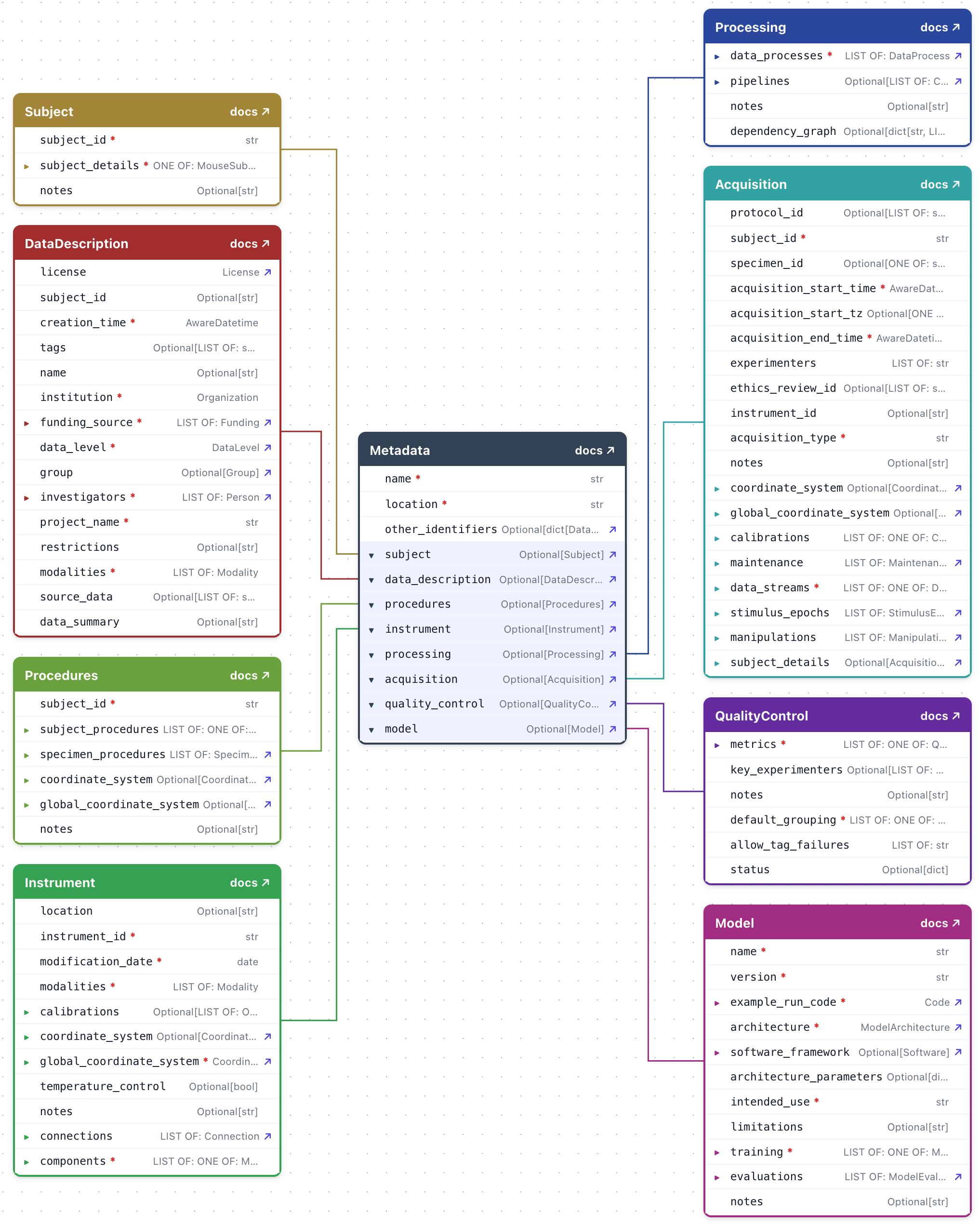
Fig. 17 The parent Metadata object and the eight core files are shown, with their fields and types. In the interactive documentation the fields storing objects can be further expanded to explore.#
How might you use this?#
We have created metadata views for you of the assets from different projects to uplevel some of the key properties. This might include information on subjects (age, sex, genotype), viruses (name, injection location), targeted structures, stimulus/behavior paradigms, etc. This were made using MongoDB queries on our metadata database, and the code for these queries are also included in our capsules.
You could further explore these metadata in the json files attached to each data asset, or by creating different queires on the database. The metadata can also be explored using a LLM or using the MCP we’ve developed for interacting with the database.